Wednesday, July 2, 2014

Henry "Tillie" Lamar Cabinet Card


Henry "Tillie" Lamar, Princeton, '86. His run against Yale in 1885 gave Princeton its only victory over Yale in a decade (1879 - 1888). The play is referred to as the "Lamar run" and it is considered one of the most notable plays of that century. The game is often referred to as the "Lamar game".
The cabinet card has sustained moisture damage, although the extreme rarity and significance of the card still makes it highly desirable.
Lamar is posed by the revolutionary war cannon that is the subject of the Rutgers-Princeton Cannon War...or is it the Princeton-Rutgers Cannon War?

Sunday, May 4, 2014

1880s Phillips Academy Andover Football Photos


Two smaller 5" x 4" albumin photos from a set of three showing a game in progress at Andover. Photos are mid to late 1880s. As has been mentioned previously in this blog, Andover was a significant feeder school for Yale. During the period of these photos Andover played such teams as Exeter, Tufts, Harvard Varsity, Harvard 2nd, Harvard Freshman, Dartmouth Varsity, MIT, Yale Freshman, Boston Latin and several other football teams.


       Another more distant view of the Andover football field taken during the Andover - Harvard Varsity Football game of 1886. Photo appears in Phillips Academy Andover on Diamond, Track and Field.

Friday, May 2, 2014

United States Naval Academy Football Team 1889


United States Naval Academy team of 1889, captained by a very identifiable Albertus Catlin (holding the football). Navy played against St. Johns, Johns Hopkins, Dickinson, Lehigh, Virginia and the Washington All-Stars, coming away with a 4-1-1 record. This was a good enough record to take the title "Champions of the South", as is documented on the ball along with the year '89.
Catlin was the commanding officer of the Marine detachment of the USS Maine (Remember the Maine) in 1898, the year of her loss in Havana Harbor.

Collegiate football in the South lagged roughly a decade behind the Eastern schools in the North. Many of the schools were still smaller sized colleges and Universities catering to what was left of the wealthier class in the decades after the war, and there had not yet been the exposure to the game. Educators hired from the northern colleges helped to bring football to the South, although it was a slow process and there was initial disinterest in the sport.

It was only in the early 1890s that football was becoming an established sport in the south with a number of schools like Georgia, Georgia Tech, Alabama, Vanderbilt, Sewanee and Auburn fielding teams in addition to the earliest schools already playing the sport like Virginia, Johns Hopkins and Navy.

It was common practice particularly in the early years, but also up through the mid 1890s to arrange for games between two schools with back and forth correspondence by representatives of the teams. This, in addition to games that were starting to become routinely scheduled. The attached correspondence below is representative of how many of the games were arranged during this period.

These letters are of particular interest to us as they reference the Champions or Championship of the South (see Navy photo above – Navy claiming the title “Champions of the South" in 1889). This championship was the most sought after and prestigious title of the time for colleges outside of the Northeast. It was more important to southern schools to be or not to be beaten by another southern or conference school than by a northern college, even of the magnitude of Yale.

The letters were sent from William W. Old, Jr., the team manager from the University of Virginia to Charles Poor, the manager of the Naval Academy (Annapolis) football team. The first letter of November 1, 1895 explains that for Virginia to play an extra game, as requested by Navy, could put winning the Championship of the South at risk, as men “in all probability would be laid out” and also the men are presently in a “crippled condition”(this is also referenced in the November 5th telegram shown below). Virginia states that they need to ready themselves for Vanderbilt on the 16th  and Old explains that Virginia is not afraid of Navy, it is merely “striving” for the Championship of the South.
The second letter, dated November 7, 1895, again stresses the importance of winning the Championship of the South, as Virginia has held it for three years and “cannot afford to lose it.


Saturday, April 26, 2014

William Roper Signed Photo c.1900

 
Signed photo of William Roper, Princeton '02, c.1900. He played end in 1899 and 1900 but is best known as Princeton's most celebrated coach. Roper coached Princeton 1906 - 1908, 1910 - 1911 and 1919 - 1930. A small photo likely given as a memento.


Sunday, March 23, 2014

Newton Athletic Association c. 1886


Photo of the Newton Athletic Association (Newton, Massachusetts), c. 1886.  I believe this was the first 1880s photos we ever picked up. The N.A.A. was already playing the collegiate game by 1885. A neat photo; rare and early with lots of character.

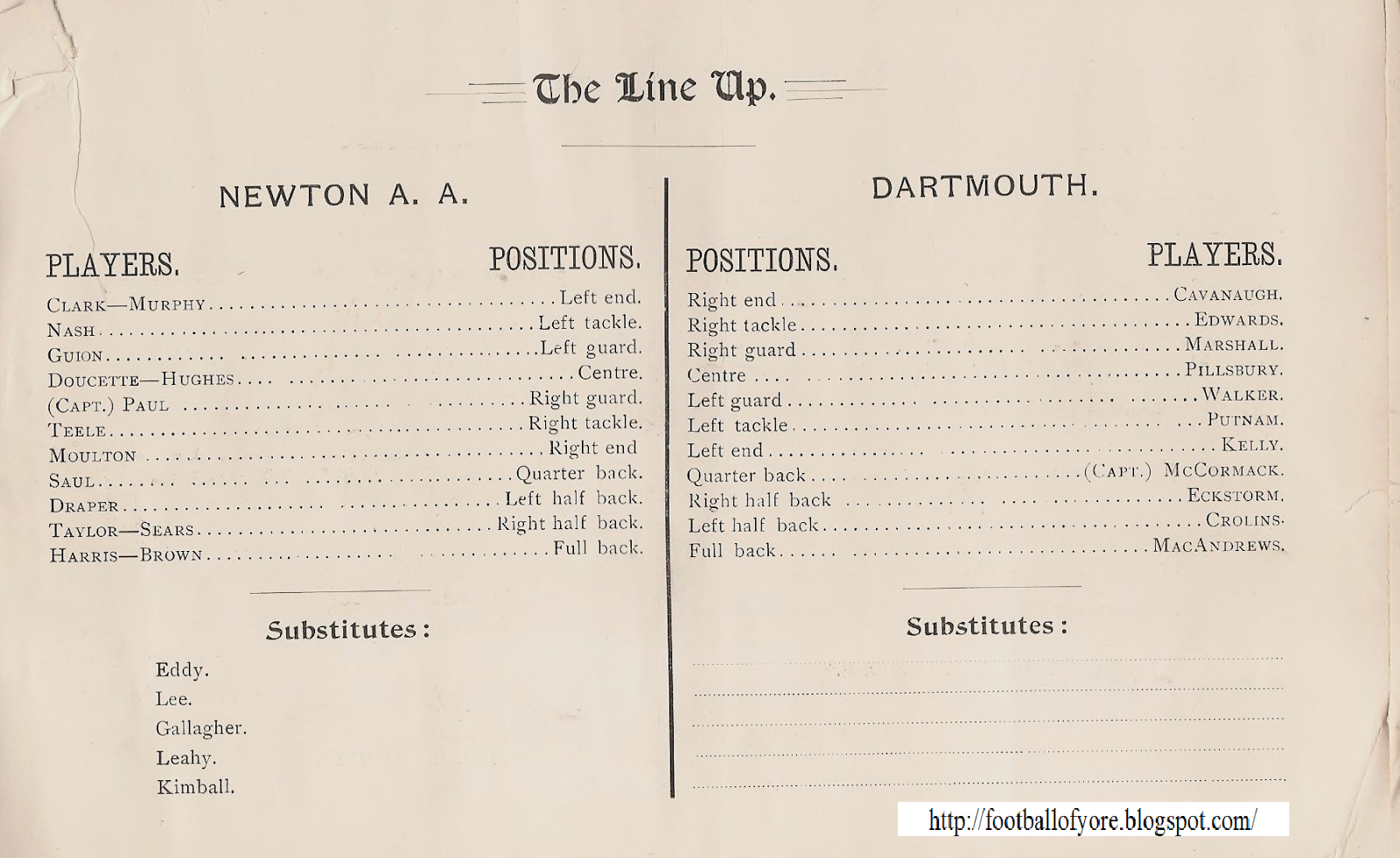
Although a decade later, I am also posting the cover and line-up page from the Newton A.A. vs. Dartmouth game from November 26, 1896 as it seemed the appropriate post for inclusion. The program itself is full of photos of Newton players and advertisements from Newton and Boston area businesses. Dartmouth won by a score of 12 to 6. At different times during the mid to late 1890s the N.A.A. also played such colleges as Brown, Tufts, Harvard and Yale.


Gresham Poe / Princeton Hockey 1902 / Northampton Hockey Trophy


Although Gresham Poe (Princeton 02') saw limited playing time on the football field, he was the sixth in a line of brothers that all played football for Princeton. He is second from the left in this 1902 Princeton hockey photo, his sport of choice and the sport he excelled in.  Before playing hockey for Princeton, Poe played for the Northampton Hockey Club of the Baltimore Hockey League, signing an agreement to play for them exclusively beginning in November of 1897, for the 1897 - 1898 season.   The Poe brothers have always been of interest to us.


The Northampton Cup, the oldest American hockey trophy extant. 


To give you an idea of the detail and quality of the workmanship on this trophy, together, these skates are 1 3/4 inches in length. The entire trophy is sterling silver and was crafted by the Baltimore silversmiths Hennegen, Bates & Co.


Hockey in the United States was gaining in popularity, particularly in the year 1896.                     


During the winter of 1895-1896 the Hockey Club of New York (made up solely of Canadian transplants) (what baseball was to Americans hockey was to the Canadians) played several matches with two teams from Montreal, the Montclair Athletic Club and the Baltimore Athletic Club. 
College hockey saw both Yale and Cornell playing their first games of any note during 1896.  Brown, Columbia, Harvard, Princeton, and Yale later founded the Intercollegiate Hockey League in 1898. 
Social clubs around New York City also started to take up hockey during this time period. Clubs including the Union Club, Calumet Cub, St Anthony Club, the Racquet and Tennis Club and the Knickerbocker Club all competed for a Cup presented by Racquet and Tennis Club member H. Percy Chubb.  
Two major leagues were formed over the 1896-1897 season in the United States. The Amateur Hockey League of New York established in November of 1896 included the New York Athletic Club, the St. Nicholas Skating Club, Crescent Athletic Club and the Skating Club of Brooklyn. Shortly thereafter, in January of 1897, the Baltimore Hockey League was formed with four member teams, the University of Maryland, Johns Hopkins University, the Maryland Athletic Club and the Northampton Hockey Club. 
The New York League played for a Loving Cup trophy donated by Frank Slazenger, first won on March 23, 1897. The Baltimore Hockey League played for the Northampton Cup, presented by J.L. Filon, first won in the championship game between the Maryland Athletic Club and the University of Maryland Hockey Team on March 22, 1897, but that was only the beginning of a contentious fight for that cup that continued off the ice and into the courtroom. These trophies represent the two earliest and most significant trophies from the beginnings of American Hockey. The current whereabouts or even the existence of the New York League Cup is unknown to us. 
To bring some perspective to this time period, it was only four years earlier that Lord Stanley of Preston awarded what we now know as the Stanley Cup to Canada’s top ranking amateur hockey team, the Montreal Hockey Club on March 17, 1893.    

 
We were very fortunate to have been able to acquire this trophy. It had been sold several times in past years and no one had recognized it or its significance. This is one of the most historically significant pieces of North American hockey history, and we are happy that we can now share it through this blog. There is a substantial amount of fabulous material we did not include in this blog, especially from older newspaper articles, and another potential intriguing twist in the trophies history. If we ever get the time we may include these and expand this posting.
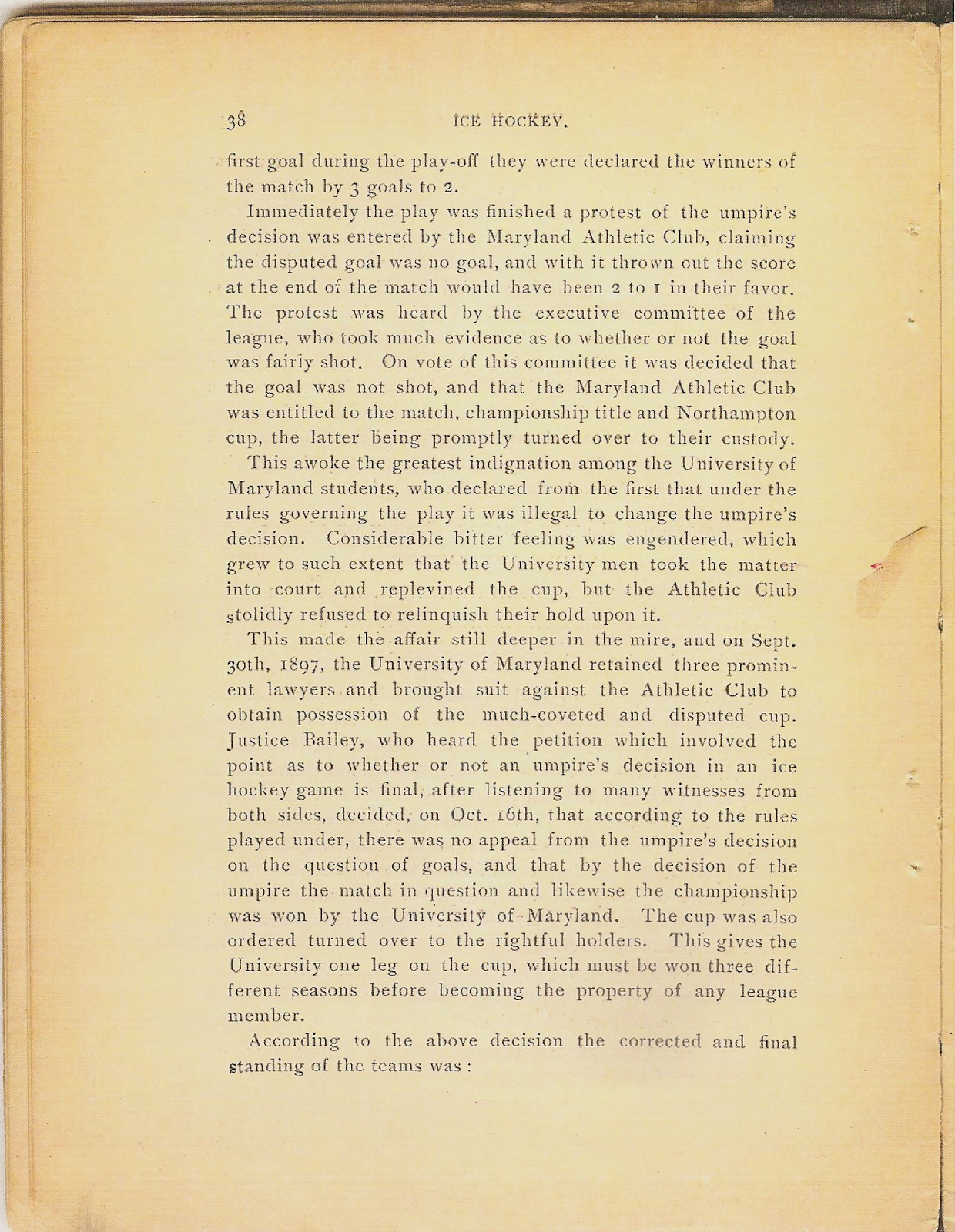
I am including scans of 5 pages from the 1898 Ice Hockey and Ice Polo Guide, published by the American Sports Publishing Company in New York, as there are no copyright restrictions, and this chapter gives a wonderful summary of early Baltimore hockey and the fight for and the significance of the Northampton Cup. 
I also include four pages from the 1898 edition of the University of Maryland’s Bones, Molars and Briefs, which includes a photo of the 1897 University of Maryland Hockey Team with the Northampton Trophy and gives a more biased view of the story behind taking possession of the Northampton Cup.


      University of Maryland Hockey Team (1896/97) with the Northampton Trophy


In addition to the above, from other sources, the following information is of interest.

Relative to the goal in question, the league executive committee met and determined that the goal was illegal and that the Maryland Athletic Club should get the cup. This was based on overwhelming evidence that the goal was in fact shot over the goal posts. Written statements from those in attendance, including referee MacRae, all agreed that the puck was shot from between one to two feet higher than the goal posts and should not have been allowed. These statements were specifically from individuals with no ties to the interests of M.A.C.

On the flip side, over a dozen “Varsity boys” all were in agreement that the puck was both between the goal posts and six to eight inches below the tops of both. This reminds me of the cliché that one person lies and the others swear to it. The committee ruled that M.A.C. had won the game by the score of 2 to 1.
The Varsity men who were present after the executive committee issued their ruling were said to have expressed their sentiments using “beautiful language, soft and sweet”.

As was described above, a court case ensued, the end result being that the University of Maryland was granted the championship and possession of the cup. The court ruled that the umpire’s decision is final and cannot be reversed.*

* This comment added on April 20, 2025. We have been updating and adding to many of our posts lately and this is one that I always wanted to get back to and expand upon. For now let me just add one comment, being that the Umpire, Walter Whitehurst was in fact related to two players on the Maryland team, Jesse Herbert Whitehurst and M. Morris Whitehurst. I'll leave it at that.


The following is taken from Bones, Molars and Briefs, 1898 


Potential search terms:  oldest American hockey trophy , oldest hockey trophy , early American hockey , early North American hockey trophy ,

1875 Tufts Football Eleven Stereoview


An amazing and scarce example of early photographic football. We have collected stereoviews for decades, routinely attending photographic ephemera and related shows. In twenty five years only two of the pictured views have surfaced (we were lucky enough to find both of them and sold one to a fellow vintage football collector) that we are aware of, and this is the only 1870s or 1880s football team stereo view known. It is identified on the reverse as the "Foot Ball Eleven". The Tufts 1875 team played Harvard on June 4th at Jarvis Field (rugby-style football) and won by a score of 1 to 0, a game Tufts and others contends is the first true American intercollegiate football game. On October 27th a rematch would allow Harvard to even the score with a 1 to 0 win in Medford, although Tufts far outplayed Harvard and the win was due to a mistake and the resulting official's determination.
If you are not familiar with stereoviews you are really missing something. Looking at the photo with the appropriate viewer creates a three dimensional image - its like going back in time and being present when the photo was taken.


1876 photo of what is likely the graduating class for that year. The senior class had only 13 or 14 students; therefore this may represent that class along with post graduates and divinity school students. All of the varsity football players from the class of 1876 appear to be in the photo.


Both of the above stereoviews were taken on the steps of Ballou Hall, the first building on the campus of Tufts College. Originally called College Hall it was renamed for the college's first president Hosea Ballou. This photo is from an 1880 Tufts class/photo album in our collection.