Tuesday, August 9, 2022

Scarce 1871 - 1872 Pillbox Rugby Football Cap


This post and the post to follow will feature two of the rarest examples of football headgear. It took us close to two decades to locate an example of a rugby football pill-box cap, the subject of this post, and the only other example we know of is in the National Football Museum, Manchester, England, dating from the same years.

This cap is an 1871-1872 Manchester Football Club Member’s Pillbox Rugby Cap. A hooped pillbox style cap, labelled by the manufacturer thought to be Christys Hat of London or Carver & Company of Bristol, and "confidently dated" by the club. In an excellent state of preservation. 

This cap was ‘deaccessioned’ from the prestigious Manchester Rugby Football Club collection along with a number of other early and rare caps and jerseys. Most of the 1870s and 1880s caps and jerseys from their collection belonged to known players or were from notable competitions, and have “been in the possession of the Manchester club for generations”. 

“The founders of the Manchester Football Club (Rugby Football) can justly be described as the pioneers of the Rugby game, not only in Lancashire but also in the North Of England”. Its chief founder was Richard Sykes (a onetime Captain of football at Rugby School) who had been arranging Rugby games back into the 1850s. The MFC was officially founded in 1860.

These caps are incredibly rare, even in England, and the limited number of those from the early days of the sport in this country, from the 1870s up through the early/mid 1880s, imported or manufactured here, appear to be nonexistent at this point. Outside of museum collections this is the only football pillbox cap we know of.

As early as 1871, Peck & Snyder of New York advertised in “The Book of Rules of the Game of Foot Ball” the importing of Rugby and English Match Balls, Association balls as well as football pants, shirts, caps and belts.  

A scarce and most important example.

Examples of such football pillbox caps:

The 1878 Brown football team (it’s first team), photo in “Evertrue: The History of Brown Football”, 2003, pg 2.

See the Antiquefootball.com write up on “The Football Cap”, from March 9, 2020.

Harpers Weekly, Illustration “Football-Collared”, December 1, 1883.

Illustrated England v. Scotland, 1872, from Sporting Dramatic News, 1875

Also see a cropped section of a c. 1870 CDV, which I bid on and lost, copied off the internet and pictured below.


               Please see related posts on this blog, March 31, 2022 and April 7, 2022.


Sunday, June 12, 2022

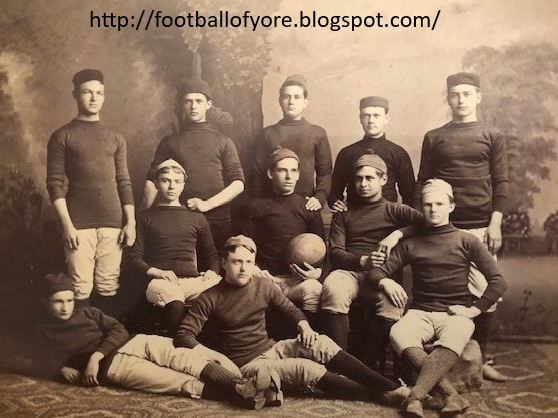
Harvard Class of 1886 Freshman Football Team c.1882


Last weekend I was just over the border in Connecticut and found this Harvard class of 1886 football team photo, presumably taken in 1882. It's a really nice early photo that draws you in. Framed in a much better than average frame, having a birdseye maple central band. The mat has been damaged and pieced together on the right side. Very early Harvard football photos are a passion of ours and are very difficult to come by.

 Kimball (Marcus Morton), far right in the middle, went on to play for the University team in 1883 and in 1884, when he was captain.  His left arm rests on Adams (George Casper), who played for the University eleven in 1882, 1883 and 1886.

Adams was named as ‘field coach’ for Harvard from 1890 -1892, sharing coaching duties with George Stewart, ’84. Before Harvard, Adams attended and played football at Adams Academy, and was a great grandson of president John Quincy Adams. I have a late 1870s photo of an Adams Academy football team that I believe has Adams in it, however players are unidentified and at present this is just conjecture. I may be able to clear this up with a trip to the Quincy Historical Society which retains many records and photos (including sports photos with identified players) from the Adams Academy, which closed in 1908

 The team roster includes Adams, Haughton, Dewey, Hartley, Vogel, Burnett, Woodbury, Clark, Phillips, Kimball, Beck, Austin, Littauer as a substitute, Guild , the manager. 

The ’86 Freshman’s teams record in 1882: 

‘86 v. Roxbury Latin, won by ‘86

’86 v. Exeter, won by ‘86

’86 v. Andover, won by Andover

’86 v. Yale, Tie game (Dec. 02) 

Another source has them playing five games, without listing the individual contests, ending with a record of 3-2-1. 

The ’86 freshman challenged Dartmouth to a game, but this was “respectfully declined”. 

This is a Pach Bro’s photo. Pach was based in New York City and travelled to college towns somewhat seasonally to take yearbook, class and sports photographs. They were generally the photographer of choice for senior classes at Yale, Harvard and Princeton, but college classes would vote on who they wanted to be their photographer. For example, Pach was chosen by Yale’s class of ’82, while the ’82 Sheffield School at Yale chose Notman as their photographer.


                                                                  Kimball and Adams


Monday, June 6, 2022

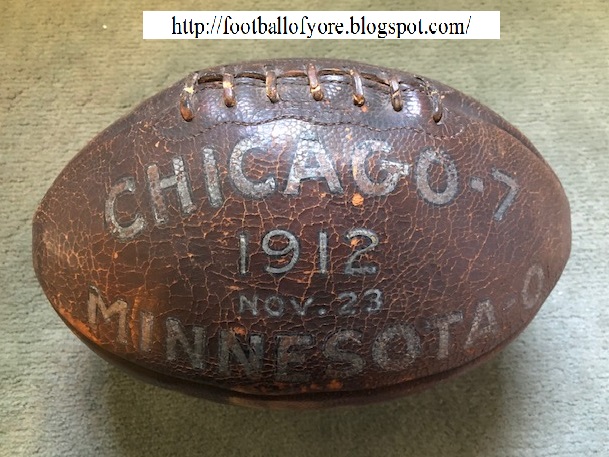
1912 Chicago v. Minnesota Trophy Football - The "Floorboard Hoard"


 This 1912 University of Chicago (v. Minnesota) trophy ball was one of the earliest balls from a larger collection of  University of Chicago trophy footballs that came up at auction a good number of years ago. The exact number of balls in the collection appears to be 23, based on the referenced lots in the original auction catalog. Most of the balls date from the 1920s, with several as late as 1932. 

All of these footballs were found together during a home inspection, in the crawlspace of a Hyde Park Chicago home, where they had lay hidden for 70 plus years. 

I have nicknamed this collection, somewhat in jest, in the manner used with recently discovered and significant old collections of baseball cards that come to auction.  Encapsulated cards are labelled with names like the “Black Swamp Find” or the “Lucky 7 Find”, and so on. We don’t collect baseball or any type of sports cards, so we don’t know if they are just having fun or take this somewhat seriously. 

Well, “The Floorboard Hoard” seems appropriate for these balls. And now that it’s in print it is a done deal. 

The 1912 team was coached by Amos Alonzo Stagg and they ended their season with a 6 -1 record.

This ball is pictured in “Antique Sports Uniforms and Equipment, 1840 – 1940, Baseball – Football – Basketball, 2008, page 91. It has an embossed Spalding seal on one of its panels and embossed patent number and date by the laces. Ex Dan Hauser collection.


Sunday, June 5, 2022

Scarce Rowing Coxswain Ambrotype c. 1859


Every so often we find a wonderful early piece from a sport other than football that we like to share on the blog.  This is an exceedingly rare sporting Ambrotype c.1859; any sports related photo from this period would be considered a scarcity. This photo is of a coxswain (rowing) and at this point in our research we believe the boat (the Prioress) to be from the Potomac Barge Club. 

By the mid 1850s the daguerreotype was being displaced by the ambrotype, somewhat cheaper and easier to produce. The ambrotype created the image on glass as opposed to the earlier daguerreotype which used silver coated copper plates. The image is crystal clear. The cheeks are hand tinted.


Monday, May 23, 2022

St. Paul’s School Intramural Football Clubs c.1907 / Hobey Baker


Borrowing from our write-up of a previous blog post showing another (c.1909) St. Paul's School photo (see entry dated March 21, 2019): All students took part in intramural sports at St. Paul’s School in Concord New Hampshire. St. Paul’s was an exclusive boarding school that was a feeder school for the Ivy League. New students were assigned to one of three athletic clubs, Isthmian, Delphian and Old Hundred. The pictured photograph shows each of the athletic clubs during the football season, assembled at one time.
The school eleven would be made up of the best amongst the three clubs.
Of particular interest, in the rear row for the Isthmian club is Hobey Baker, later considered one of the best football and hockey players in the country.
After St. Paul’s, Baker played football and hockey at Princeton and was inducted into both the College Football Hall of Fame and the United States Hockey Hall of Fame.
For related details on Hobey Baker see blog entry dated June 13, 2015.

A large and fascinating photo measuring  16 3/8” x 9 5/8”.


                                                       Close up of Hobey Baker

Thursday, April 7, 2022

Spectacular 1827 William Webb Ellis Signed Letter


Autographed letter signed “W.W. Ellis”, Brasenose College, (Oxford), 2 July 1827, written while a student at Oxford University, to George Harris, Rugby (School), and acknowledging receipt of 60 Pounds from the Trustees of Rugby School “for the whole of my exhibition”. This letter is one page, measuring approximately 8 7/8” x 14 ¾”, with integral address leaf and an intact Brasenose College seal with postmark of the same 1827 date.

The term ‘exhibition’ refers to a form of scholarship from the Rugby School to a select number of students to either attend Oxford or Cambridge.

Webb Ellis came up to Brasenose College (Oxford) in 1825 graduating in 1829. Webb Ellis after graduation was then associated with several churches as Chaplain and Rector until becoming Rector of Magdalen Laver in 1855, serving there for fifteen years.

Provenance: Ex-Norris McWhirter (1925 – 2004), by family descent. Norris McWhirter was a British writer, political activist and co-founder with his brother Ross of the Guinness World Records. Previous to this, members of the Harris family who held the clerk position at Rugby School continuously from 1740 – 1949.

The place of Webb Ellis’ grave was unknown until 1959 when Ross McWhirter (three pages of notes that accompanied this letter written by Norris McWhirter, mentioned that his brother Ross (1925 – 1975) was murdered by the IRA) traced his grave to caveau no. 957 in the cemetery of Vieux Chateau in Menton, France.

Webb Ellis is probably the most famous name associated with the history of the sport of Rugby. Additionally, the Rugby World Cup is named for him, the Webb Ellis Cup.

We know of only two other Webb Ellis signed letters – one owned by the Rugby School and the other by the World Rugby Museum. According to Norris McWhirter's notes,there is one known signature of "W.W.Ellis, Rector", in a parish register of Magdalen Laver, Essex.

The controversy - did Webb Ellis invent the game of Rugby?   I’m not sure where the actual claim of invention came from; it certainly wasn’t from Webb Ellis himself. This was an unfortunate choice of wording that caused a stir that has become bigger than life. Did Webb Ellis pick up the ball and run with it, against the established rules of the game at the time - most certainly (see also the previous blog entry on Matthew Bloxam). Did others do the same in the years to follow, while it was still against the rules, of course. So, did Webb Ellis invent the game of rugby as a result of this run, the gist of the controversy - of course not.  There are very few instances of a sport being ‘invented” by one individual. In fact, the only major sport that I can come up with that is actually attributable to one individual is basketball, “invented” by James Naismith (see blog posting dated October 25, 2019).

The sport of rugby came about as result of an evolutionary process with a good number of feeder streams that eventually coalesced. Webb Ellis’ actions contributed to these changes in an important manner, as did the actions of others at later times. There were the schools, like Rugby, Eton, Charterhouse, Westminster, Harrow and a fair number more that each was playing a game within its own boundaries and with its own rules. Eventually they would settle on one set of rules when the Rugby Union was established in 1871. This is analogous in many ways to the games played by American colleges before the advent of conventions, conferences and associations to try to fix a set of rules so that colleges like Princeton, Harvard and Yale could play one another without having to set ground rules and concessions before each game (see our blog entry dated June 13, 2015 for a more detailed description of this period in American rugby football).  In the end, American football adopted the English Rugby game, and as Walter Camp wrote, "it is from the Rugby Union Rules that our American Intercollegiate game was derived". Every book on the history of early American football has a section or chapter that addresses how our game borrowed from the English game of Rugby and specifically mentions the contributions of the Rugby School and William Webb Ellis. Looking in our own library we found this in books written by Walter Camp, A.A.Stagg, D.G, Herring, Parke Davis, Morton Prince and a dozen others.

An extraordinarily rare, historically significant document.  This would be considered the centerpiece in the most advanced collections of football and rugby history.

Thursday, March 31, 2022

1876 Harvard Freshman Football Team (Class of 1880)


Very early and rare Harvard rugby football photo from 1876

The class of 1880 freshman team played the Yale freshman twice in 1876. The first game, in November, was played in New Haven. The roster was listed as Osborn, Clark, W. Hopper, Jordan (Captain), Winsor, Nickerson, A.W. Hopper, Tebbits, Tiffany, Holden and Davis.

The second meeting with the Yale freshman was in Boston, in December, in front of several hundred spectators.

The Harvard roster for this game was much the same and was listed as rushers: Davis, Tibbits (Tebbets), Bacon, Holden, W. Hooper, Nickerson; halfbacks Blanchard, E.D. Jordan (Captain (pictured with the ball)), Grant; backs Winsor, Osborne. Substitutes are listed as Tiffany, Hooper and Clark.  Harvard won the game by a score of 3 goals, 2 touchdowns to Yale’s 0 goals and 0 touchdowns.

The most noteable player in the photo is Robert Bacon, top right, who played on the University football team for three years, 1877,78 and 79 (captain in 1879). He rowed crew in 1880. Bacon was an Assistant Secretary of State for four years followed by a three year stint as Ambassador to France. Bacon had a lucky streak which included “missing the boat”, which happened to have been the Titanic.

Note: In the photo to the right of captain Jordan is John Sever Tebbets. A good number of different sources list him as Tibbits or even Tebbits, which are incorrect. Tebbets did play for the varsity University team in 1879.

Besides being one of the earliest Harvard football photos (we know of only six earlier photos of  Harvard football teams, including those from the Harvard - McGill games of 1874 and 1875, and the Harvard - Tufts stereoview from 1875 (see blog post dated December 26, 2019)) , this photo is of great rarity in that it shows players wearing pillbox caps. We've only seen a handful of football photos with team members wearing pillbox caps. These include the later 1878-79 University of Michigan and the 1878 Brown football teams.  In the case of the Brown team, the caps very well could have been based on the pillbox caps in the Harvard photo. New to the game in 1878 (apparently no one involved  had seen a game), Brown sent Alfred Eddy and George Macom to Harvard to view practice and pick up on the particulars of the game.  Uniforms, a last minute consideration were made by a local tailor and finished just days before their first and only game of the year.  

The original label from the back of the frame. Of particular interest to us is the last line of the label, referencing the framing of "college shingles of all types" (see our blog post dated June 13, 2015, "The H.F.B.C. and the Foundations of Football: Beginnings of a Game: 1873 Membership Shingle"). Beck Hall, referred to on the label was a Harvard residence hall.