Tuesday, May 21, 2024

Spalding Padded Lace Up Foot Ball Jacket c. 1907


Spalding was very late to the game marketing the pictured quilted and padded football jacket. It appears that Spalding manufactured the padded jacket starting in the fall/winter of 1907 to compete with other Canadian or English manufacturers that had already been producing these jackets since the very late 1890s, primarily for Canadian University football teams where they were a common part of the football uniform. These jackets were worn from roughly 1899 to 1910.  

To our knowledge, Spalding never tried to actively market these jackets in the US, although we have seen a fair number of examples of padded jackets being worn by players on teams in the US at the turn of the century, mainly in northern states, from New York to California. Such jackets, particularly in the early years would seem to have made sense and would have been the perfect compliment to padded football pants, providing similar protection.

The evolution away from these jackets and towards sweaters, sew on pads and padded jerseys was already well underway by the time this jacket was manufactured. In fact Spalding was strongly marketing and pushing these other items in their advertising.  Spalding could make considerably more money selling jerseys, sew on pads, sweaters, etc., than it would from football jackets that were as a rule surprisingly inexpensive.  As an example of this, in 1906 we see pads were priced at .50 to 1.00 a pair, shoulder pads 1.00 to 2.50, and sleeveless football jackets selling for between .40 and 1.25, depending on quality.  Such factors account for the lack of existing examples of these jackets. Padded jackets continued to be available for a few more years (despite lack of demand) and were worn by a few Canadian University teams (more than others), likely due to the reuse/recycling of older equipment. One such University that continued to use these padded jackets was the University of Toronto. The photo of the 1907 team illustrates the variety of padded jackets that had existed up to and at the time.    

This Spalding football jacket is in mint original condition. As with all lace up Jackets/vests that we in the hobby see so infrequently, this too is a scarce example, being the only Spalding example known to the hobby or having been seen by major Spalding collectors. It really is a wonderful piece to handle.


                                         1907 University of Toronto Foot Ball Team 


Thursday, May 16, 2024

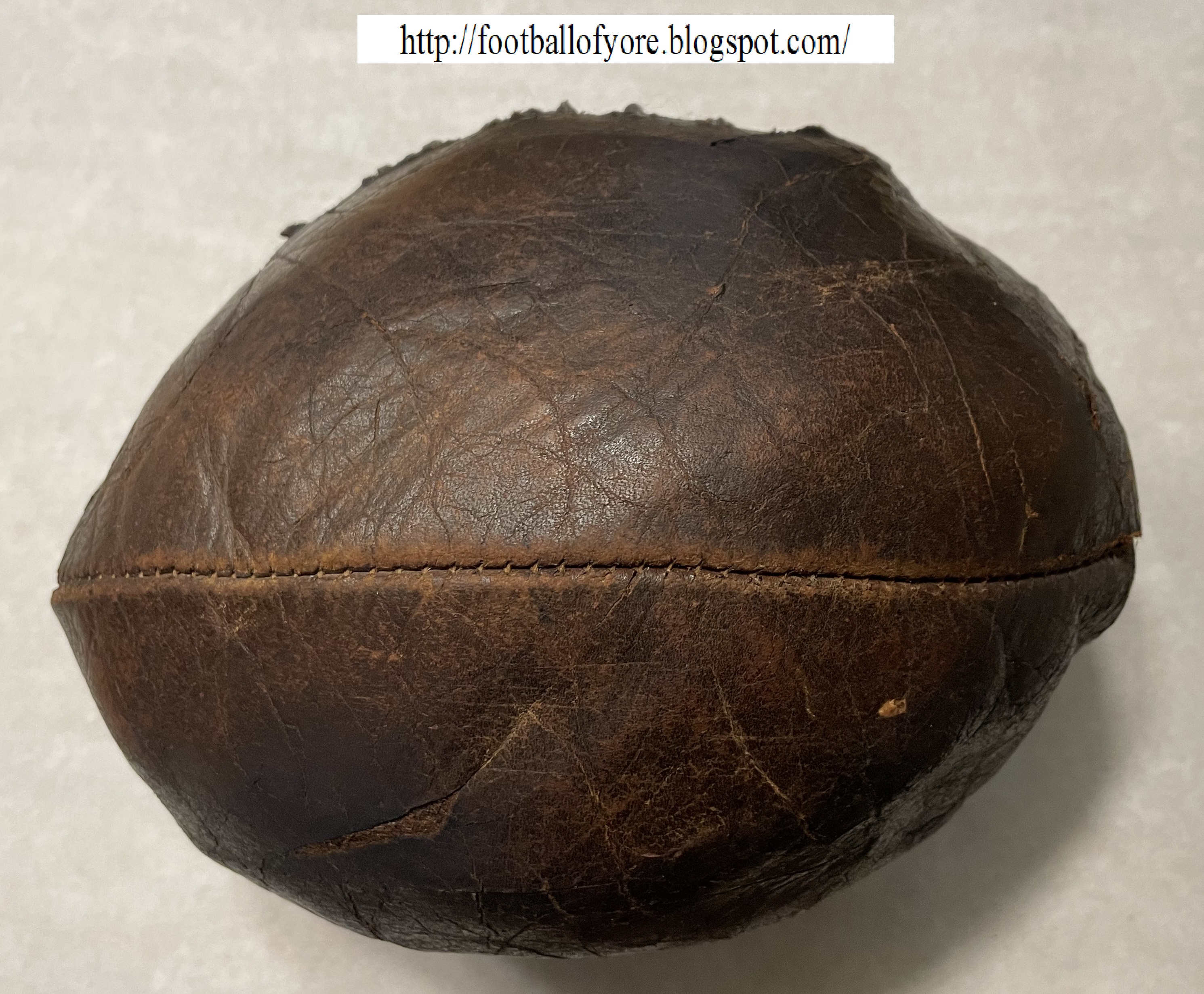
Early And Very Rare C. 1885 Early Leather Football


 Very early c. 1885 football. Balls this early very rarely show up and this is a well used survivor.

A similar example is pictured in Antique Sports Uniforms by Hauser, Turner & Gennantonio.

Ball's circumference is 24" x 26 1/2".


Tuesday, April 16, 2024

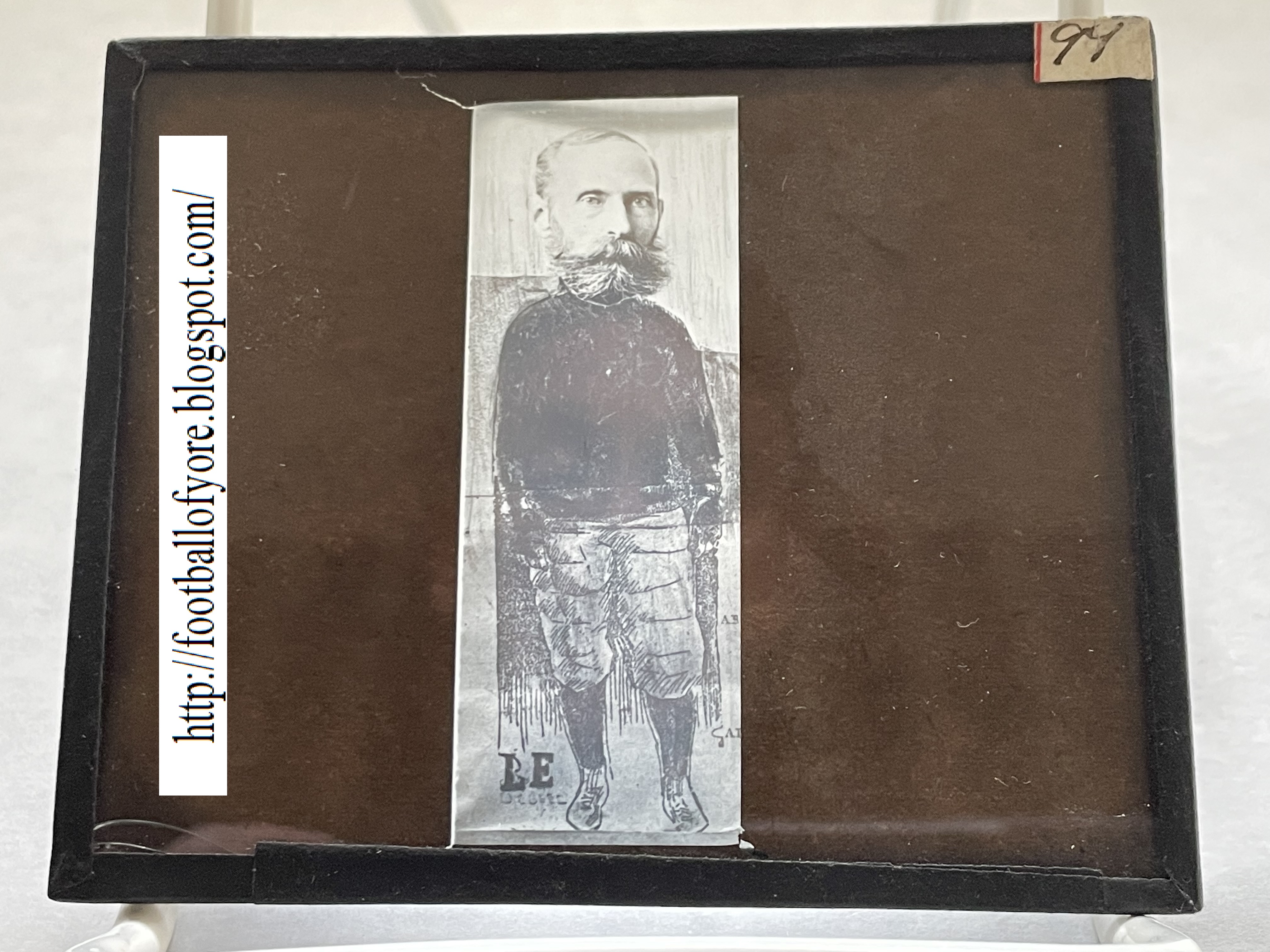
Football / Political Magic Lantern Slides c. 1890s / Early 1900s


Reminiscent of the Duke presidential baseball card set where photographs of known politician’s heads are placed on sports bodies. In the case of these five slides pictured in this post the same is true, the difference being that the bodies were etched/drawn and they are c.1890s/1900s football. The slides are numbered and it would be reasonable to assume there were others in the set, although they may not have all been football related.

I am not a political researcher, but one of these slides (number 94) appears to be John Edward Kelly (1852-1933).

We have never seen any other football caricature lantern slides like these. If not one–offs, then they are certainly scarce examples.


Examples of the Duke presidential baseball cards (Grover Cleveland and Benjamin Harrison) that are coming up at auction later this month.


Thursday, March 28, 2024

1901 Dartmouth vs. Brown Broadside


 1901 was a rebuilding year for Dartmouth after three successive years of failures, particularly against rivals Brown and Wesleyan.  Walter McCornack, Dartmouth ’97 was brought in as head coach and John W. Bowler (ex-assistant trainer at Harvard) was hired for his well-known expertise.

From left to right in this very unusual Dartmouth vs. Brown broadside, announcing the November 28th game, are trainer John W. Bowler, Captain J.C. O’Connor and head coach Walter McCornack.  This is an important piece of Dartmouth football’s “reconstruction” era history.

McCornack had been Captain of the Dartmouth football team in 1895 and 1896. After graduating he spent three years coaching Phillips Exeter and then came back to coach Dartmouth in 1901 and 1902.

J.C. O’Connor, Captain of the 1901 team went on to coach football at Bowdoin, Andover and other institutions before returning to Dartmouth as head coach in 1907 and 1908.

John Bowler, the ex-Harvard assistant trainer spent many years at Dartmouth, besides football, in a number of capacities, including coaching track and gymnastics.

Dartmouth’s record for 1901 was 10 and 1, losing only to Harvard.

This book, Three Years of Football of Dartmouth, is exclusive to the 1901, 1902 and 1903 football seasons.


Friday, March 15, 2024

Neilson “Net” Poe / Class of 1897 Freshman Football Team Photo c. 1893


 Neilson was the third youngest of the six Poe brothers that attended and played football at Princeton. He played for the varsity in 1895 and 1896. After serving in WWI  (awarded the French War Cross and the Distinguished Service Cross) Poe returned to Princeton as an assistant coach, a position he held for 44 years.

Poe is pictured front row (seated) center with other members of the class of 1897 freshman football team; photo taken in 1893. Information on the Poes appears elsewhere in this blog, including entries dated February 13, 2014, March 23, 2014, June 25, 2014, October 17, 2017, December 25, 2020, December 31, 2020,and December 18, 2021 and January 22, 2023.

 A number of other members of the class, pictured in this photo also played on the University Eleven. Among them, two rows back from Poe, and directly behind him is W.W. Church; related  blog entries July 21, 2013,  September 14,2013,  January 2, 2014,  February 13, 2014,  November 2, 2014 and June 18, 2017.


Tuesday, February 13, 2024

Marshall Newell: A Memorial For His Classmates and Friends


 Years ago we wanted to acquire an original copy of “Marshall Newell: A Memorial For His Classmates and Friends”, but when the book became available, which was rarely, they were far too expensive. I found a copy earlier this month, in very nice shape, and we purchased it. Coincidently, it was delivered on December 24th, the anniversary of his death, 126 years ago (1897).

Having read the book today, I found myself with a greater admiration for Newell and the way he led his life: man of quiet moral character who had a remarkable tie to, and appreciation for, nature. He was loved, admired and respected by those who knew him and by those who only knew of him. The excerpts from his diary, published in the book, were only slightly removed from true poetry in the way he wrote them. He was considered the ideal to which all Harvard students wished to emulate.

It is a wonderful book that I recommend reading (a quick read). It leaves its readers wishing for times when things were more ordered, simpler, and more decent.

Reading this book, at this moment in time, made me think about how much of the current Harvard undergraduate student body as well as Harvard’s leadership represent the antithesis to what Newell represented and believed in. How disappointed he would be.

Marshall Newell, April 12, 1871 – December 24, 1897, was one of only four individuals who were four time All-Americans in football, the others being Truxton Hare, Gordon Brown and Frank Hinkey. Newell prepped at Phillips Exeter. He played on the Varsity Eleven at Harvard in 1890, 1891, 1892 and 1893 and rowed Varsity Crew in 1891, 1892 and 1893. The Newell Boathouse on the Charles River was constructed in his memory. He died in a railway yard accident at 26 years of age.


Monday, February 5, 2024

Rare Modified Batwing Style Nose Guard / Penna Guard Style / 1906


One of the rarest styles of nose masks. This modified batwing style guard (almost identical to Penna Guard nose masks) was manufactured near the tail end of nose guard usage, which may account for its significant rarity. It was inscribed by its owner, 1906.

Original strap intact, guard overall length 5 5/8”.