Wednesday, November 30, 2022

1876 Trophy Cup Awarded To M.J. Druitt / Fives Champion / Cricketer…Jack The Ripper?

We always look for rarities in sports memorabilia, and when available we like to pick up items that belonged to or were used by the athletes themselves. We have been fortunate to find and collect such football items that belonged to Walter Camp, Mrs. Walter Camp, Glen "Pop" Warner, Bill Edwards, William Church, Mel Hein, Morton Prince, Edgar Wrightington, Johnny Poe, Arthur Poe, Benny Friedman, as well as others. We also have important crew related items belonging to Joseph S. Fay, Fred Plaisted. 

The pictured trophy is a sports rarity awarded to Montague John Druitt in 1876 for the Winchester College Fives competition. Druitt (1857-1888) was educated at Winchester College and in his final year there, 1875-1876, was school fives champion and opening bowler of the cricket team. Later in his short life he was known as a cricket player of some note. He became, and remains, one of the leading suspects of being Jack the Ripper. He died in 1888 after what was thought to be an apparent suicide, although circumstances make it highly likely that he was murdered, again, probably in connection with the Ripper case.

Two books have been written on Druitt, Ripper Suspect: The Secret Lives of Montague Druitt and Montague Druitt: Portrait of a Contender . From a sporting perspective, both are very heavy on his time playing cricket.

Significant flaws exist in each theory on who Jack the Ripper was, including one that claims to have DNA evidence.  At the time there was a propensity to blame certain ethnic groups or religions, or to look at social status or believed sexual orientation when assessing guilt for crimes. This held true when looking at the suspects thought to be Jack the Ripper. The police were fully embedded in this skewed assignment of blame as well.  After roughly 134 years it is unlikely we would ever know for sure who the Ripper's identity is.

This is barely a 'scratching the surface' overview of Druitt. For now let it suffice that this trophy is a rare and unique part of history with both its sports and significant Ripper associations.

The trophy is unusual in that all of the engraving, including the school crest is gilt; 6 ¼” in height. 


Sunday, November 6, 2022

Walter Camp's Silver Flask


 An 1890s sterling silver flask having belonged to Walter Chauncey Camp; WCC monogram.  Providence, RI maker, Knowles, working 1879-1905. Camp is known to most as the "Father of American Football" contributing to its development, particularly through rules changes he initiated. An important piece that is a nice addition to our collection.  

The flask is accompanied by a nine page letter from Harriet E. Koehler, written in 1987, when she was 93, about her family and the flask. Her family had a long history of living in New Haven, where she died at 101. 
She wrote the letter to give a history of the flask and her family, and stated the intent was to document the flask was "brought into my hands thru perfectly legitimate means, and that my family history makes that clear". She had been in possession of the flask fifty years at the time she penned this letter. 

Her father Henry, who died in 1927 worked for 12 years at Yale's Marsh Hall School of Forestry. Two of seven of her brothers (she was the youngest)  worked at Yale in the Gardens and Greenhouses as well. They were also in charge of the horses and wagon stabled at Hillhouse barn, which was used by the Marsh Botanical Garden to dispose of debris. The brothers would oversee properties and clean out houses when they were taken over by Yale, and this included the Walter C. Camp residence. It was her brother Richard (1879-1966)  who brought the flask and other items back from the Camp home.

Related posts, September 28, 2014, June 15, 2015 and November 21, 2013 (a photo that had hung in the Camp home).


Wednesday, October 26, 2022

John Prentiss Poe, Jr. and Poe Field


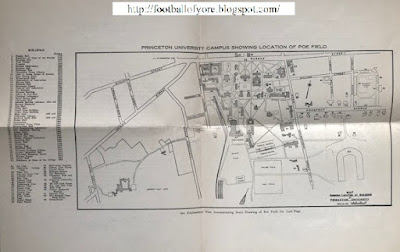
 Letter sent to Princeton Alumni in 1916 to raise money for a memorial to Johnny Poe, Poe Field.


Page 2 and 3 of the letter showing the proposed location of Poe Field (lower middle)

                                              Last page of the alumni letter, showing Poe Field


Accompanying the letter was a really neat 16 page publication on Poe I hadn't seen before. It includes letters, poems, photographs and information not found elsewhere.

Tuesday, September 13, 2022

1930's Benny Friedman Endorsed Football Cleats


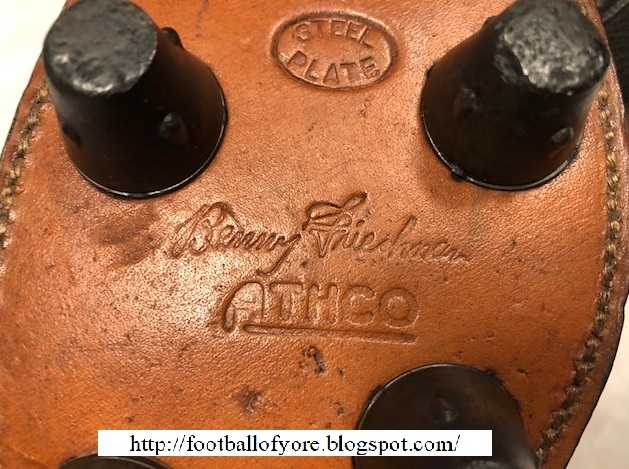
Benny Friedman endorsed/signed products are exceedingly rare and these wonderful cleats are the only ones we've come across in seventeen years. Quality built shoes in great condition. Athco stands for Athletic Shoe Company of Chicago, Illinois. The owner of these shoes, R. Hass carved his name into the soles. The shoes appear to be size 12/13.


Monday, August 15, 2022

1903 Spalding Head Harness - Only Known Example


“The day of the armor helmet in football is over”.  Headline from the March 23. 1903, Boston Journal 

I came across this helmet at the May 2017 Brimfield, purchasing it and subsequently selling it to another collector (Ed Turner) that afternoon ,with a gentleman’s agreement that when he scaled back his extensive antique helmet collection he would sell the helmet back to me. Good to his word, he brought the helmet with him to this year’s May Brimfield and I bought it back. 

When the Intercollegiate Football Rules Association met in March of 1903, it decided  that the hard leather head piece, as worn during the past few years by many players on the gridiron, must be either modified so to lose its capacity of injuring an opponent or must be altogether eliminated. “It has been believed that many of the injuries received in football were due to the use of heavily protecting armor, particularly the head guards, which had grown so hard and unyielding as to give plenty of cause for this supposition”.

These “helmets made of hard sole leather have been used in mass plays as battering rams to butt down opponents…the committee believes this new rule will abolish that feature from the intercollegiate game and restore it to the old Rugby system of open play.” 

The actual rule to be passed was not yet known. John C. Bell (U Penn), a member of the committee was quoted after this meeting as saying “What other changes will follow in the way of modifying football armor of all sort I do not know. No rule on the question has been adopted nor do I trust one will be at this meeting”. The committee was made up of John Bell (U. Penn.), Walter Camp (Yale), J. Burchard Fine (Princeton), Professor L.M. Dennis (Cornell), Paul Dashiell (Lehigh and Annapolis) and Robert Wrenn (Harvard). 

It would have been at this time this helmet would have been produced, to satisfy the intent of what the initial suggested rule would address, a modification to prevent contact with sole leather, in this case by incorporating a felt/wool ring on the top of the helmet. 

When the  rules committee issued the final rule, a few short months later,  it read “If head protectors are worn , no sole leather, papier mache, or other hard or unyielding material shall be used in their construction…” . 

To conform to this rule, which specified that no sole leather whatsoever could be used in the manufacture of helmets, Spalding could not market this helmet, and came out with the pneumatic helmet (No. 70) as well a less expensive line of helmets they termed “Gray” head harnesses, made of soft leather (No.45) or canvas (No. 55). 

This helmet is based on a helmet design that differs slightly from the Spalding No.60 (that was currently Spalding’s top of the line helmet),  based on G.L. Pierce’s Head Harness Patent pictured below. 

The helmet is embossed with “The Spalding” on both ear flaps, the designation reserved for its top of the line products. 

This helmet is an absolute rarity, previously unknown to our hobby, being the only known example.


Tuesday, August 9, 2022

Scarce 1871 - 1872 Pillbox Rugby Football Cap


This post and the post to follow will feature two of the rarest examples of football headgear. It took us close to two decades to locate an example of a rugby football pill-box cap, the subject of this post, and the only other example we know of is in the National Football Museum, Manchester, England, dating from the same years.

This cap is an 1871-1872 Manchester Football Club Member’s Pillbox Rugby Cap. A hooped pillbox style cap, labelled by the manufacturer thought to be Christys Hat of London or Carver & Company of Bristol, and "confidently dated" by the club. In an excellent state of preservation. 

This cap was ‘deaccessioned’ from the prestigious Manchester Rugby Football Club collection along with a number of other early and rare caps and jerseys. Most of the 1870s and 1880s caps and jerseys from their collection belonged to known players or were from notable competitions, and have “been in the possession of the Manchester club for generations”. 

“The founders of the Manchester Football Club (Rugby Football) can justly be described as the pioneers of the Rugby game, not only in Lancashire but also in the North Of England”. Its chief founder was Richard Sykes (a onetime Captain of football at Rugby School) who had been arranging Rugby games back into the 1850s. The MFC was officially founded in 1860.

These caps are incredibly rare, even in England, and the limited number of those from the early days of the sport in this country, from the 1870s up through the early/mid 1880s, imported or manufactured here, appear to be nonexistent at this point. Outside of museum collections this is the only football pillbox cap we know of.

As early as 1871, Peck & Snyder of New York advertised in “The Book of Rules of the Game of Foot Ball” the importing of Rugby and English Match Balls, Association balls as well as football pants, shirts, caps and belts.  

A scarce and most important example.

Examples of such football pillbox caps:

The 1878 Brown football team (it’s first team), photo in “Evertrue: The History of Brown Football”, 2003, pg 2.

See the Antiquefootball.com write up on “The Football Cap”, from March 9, 2020.

Harpers Weekly, Illustration “Football-Collared”, December 1, 1883.

Illustrated England v. Scotland, 1872, from Sporting Dramatic News, 1875

Also see a cropped section of a c. 1870 CDV, which I bid on and lost, copied off the internet and pictured below.


               Please see related posts on this blog, March 31, 2022 and April 7, 2022.


Sunday, June 12, 2022

Harvard Class of 1886 Freshman Football Team c.1882


Last weekend I was just over the border in Connecticut and found this Harvard class of 1886 football team photo, presumably taken in 1882. It's a really nice early photo that draws you in. Framed in a much better than average frame, having a birdseye maple central band. The mat has been damaged and pieced together on the right side. Very early Harvard football photos are a passion of ours and are very difficult to come by.

 Kimball (Marcus Morton), far right in the middle, went on to play for the University team in 1883 and in 1884, when he was captain.  His left arm rests on Adams (George Casper), who played for the University eleven in 1882, 1883 and 1886.

Adams was named as ‘field coach’ for Harvard from 1890 -1892, sharing coaching duties with George Stewart, ’84. Before Harvard, Adams attended and played football at Adams Academy, and was a great grandson of president John Quincy Adams. I have a late 1870s photo of an Adams Academy football team that I believe has Adams in it, however players are unidentified and at present this is just conjecture. I may be able to clear this up with a trip to the Quincy Historical Society which retains many records and photos (including sports photos with identified players) from the Adams Academy, which closed in 1908

 The team roster includes Adams, Haughton, Dewey, Hartley, Vogel, Burnett, Woodbury, Clark, Phillips, Kimball, Beck, Austin, Littauer as a substitute, Guild , the manager. 

The ’86 Freshman’s teams record in 1882: 

‘86 v. Roxbury Latin, won by ‘86

’86 v. Exeter, won by ‘86

’86 v. Andover, won by Andover

’86 v. Yale, Tie game (Dec. 02) 

Another source has them playing five games, without listing the individual contests, ending with a record of 3-2-1. 

The ’86 freshman challenged Dartmouth to a game, but this was “respectfully declined”. 

This is a Pach Bro’s photo. Pach was based in New York City and travelled to college towns somewhat seasonally to take yearbook, class and sports photographs. They were generally the photographer of choice for senior classes at Yale, Harvard and Princeton, but college classes would vote on who they wanted to be their photographer. For example, Pach was chosen by Yale’s class of ’82, while the ’82 Sheffield School at Yale chose Notman as their photographer.


                                                                  Kimball and Adams